Wednesday, January 19, 2011

Lumbar Punctures are brutal

As it turns out, lack of sleep coupled with a high fever can induce fainting and seizures...especially in me. Put 10 people in a room, don't let 'em sleep for a few days, and at least one of them will end up fainting...so says the doctor I had for my first three or so hours in the emergency room on Sunday night.

The ambulance took me to the ER, where I was put on oxygen and went through a full battery of tests including a spinal tap and a CT scan. All I have is a bad case of strep throat, and nothing worse.

 Lumbar Puncture - they tested my CSF to see if I had meningitis, thankfully I did not

A big thank-you to Dr. Sehgal, Dr. Choi, and everyone else who tended to me at the hospital. :)

Stumble Upon Toolbar

Thursday, November 25, 2010

A Joyous Tryptophan Day to all Americans!

Today is Tryptophan Day, a.k.a. "Thanksgiving," in the United States of America.

In celebration, people usually have some sort of feast with family and/or friends, and express their gratitude for one another and their fortune. The centerpiece of this feast is usually a turkey or roast. Other dishes include things made with potatoes and/or sweet potatoes, cranberry sauce, and a stuffing to go inside of the turkey (if you have it.) For desert, there is pie; usually pumpkin. You can also have pecan pie, sweet potato pie, or really any sort of pie you want (since it is after all, your feast.)

Now you may be wondering whatever this nonsense is that "tryptophan" has to do with, so I shall tell ye.

Tryptophan is an amino acid; these are essential chemicals that make up proteins, your body needs them, or else....  Tryptophan is found in a variety of meats, including turkey. I have heard, though never experienced it myself (nor has anyone that I know), that eating copious amounts of turkey will make one sleepy, all thanks to this chemical. This sounds a bit silly to me, since eating enormous quantities of other meats with even more tryptophan in them than turkey mysteriously does not seem to make "them" tired. It's probably all the potatoes and pies they're piling on in addition to the turkey that is making them tired, in my opinion....

Tryptophan Day, besides a day for family, is controversial because the whole thing and all the myths surrounding it push aside (and quite frankly ignore) all the decimation, horror, and racism that the Native Americans suffered at the hands of the colonists, and would continue to (and even still do) suffer up to more recently in history. So Tryptophan Day is a day of giving thanks for what you have (like family or being able to put food on your table), and also a day to solemnly recognize the treatment of the Native Americans, and to commit to making things right and to end all the oppression and lack of equality. (Well, at least for me it is.)

In the spirit of this, there are Native American cultural festivals around this time, and the month of the November is designated Native American Heritage Month. People also volunteer to work to give/cook meals and shelter to those less fortunate, like the homeless.

Stumble Upon Toolbar

Tuesday, November 2, 2010

"Never Pass Up a Beautiful Watch"

Such is "one of the ever expanding laws" of magician, photographer, gentleman, and everything else extraordinaire, Daniel Schaefer......he's absolutely right about that watch quote, and I wish to Odin and Quetzalcoatl that I hadn't passed up buying that antique Japanese pocket watch in June. The beauty and quality of it would have been well worth the price, and even more. Ah well, there are other paths up to the mountain, and future days await which may be dedicated to climbing.

Mr. Sir Schaefer not only has words of wisdom to offer us, but _____ photographs as well. That space there is for your own adjective, or you could replace that space with two more and add in two adjectives if you want, or do anything you feel like with the space really. Go check out his photography at Outlier Imagery on Tumblr, and see for yourself.

Stumble Upon Toolbar

ENVISION: Interesting little light box


Here's a neat little video of a "sensory box" I found, thanks to the magic of StumbleUpon.

AfterEffects and an awesome projector that can detect 3D space, perhaps? I'd like to figure out how to do this...

Stumble Upon Toolbar

Cretaceous Period Dinosaur Named After Korea

The Cretaceous Period on Earth is one in which the dinosaurs (and other creatures of course) roamed; how exciting! It lasted from about 145.5 Ma (Ma = megaannum = million years 'ago') to 65.5 Ma. If you think the number 65 looks familiar to you, well, it probably does; it's about when the K-T mass extinction happened. Assuming you remember something you learned in a related science class at one point, you'll know that this is when the dinosaurs went pretty much extinct. 

...but I digress.

No, I don't own this image, so don't come after me.

Recently, a type of Cretaceous dinosaur discovered in 2003, has recently been named and, as has never before happened in paleontology, its namesake was that of Korea. This new dinosaur, Koreanosaurus boseongensis, was about 8 feet long, lived on the Korean peninsula, and was a herbivore.

You can read more about the story (in English) here at the site of the Chosun Ilbo, a major S. Korean newspaper....although I think the fact that it's South Korean kind of goes without saying.

Stumble Upon Toolbar

Moving Forward

/caution: unfinished + unpolished reflection ahead/

After this June, I will be done with high school. I will leave my school, maybe even my city and state, go to college, and move on with my life. Of course I will still have friends and family, even though I'll see them less frequently than in the past. There are people that I know now that I will slip away from, and lose contact with, but even as sad as that may be, I'm not worried. Even as stressful and daunting this college process may be at times, with writing essays and tests upon which so much weight is lain, trying to pull something together and say "this is where I might want to head in life," and getting lost in the names of a hundred places that are all viable options for continuing one's education, I'm not worried.


Even if I don't get in to the colleges I most want to attend, I may be upset, but not worried. There is more than one path to the mountain, or to Rome, or London, or Daejon, or wherever you want to go. I will try the best I can to go down my intended path, but if that doesn't work out I may be forced to consider alternatives. This will happen in life, and I am not going to complain about it even though I may not find it enjoyable to go through.

Things are meant to move forward. My high school has changed from how it was in its first couple years, for better and for worse. Though I regret what changed for the worse, I know that it may not be "for the worse" according to others, and that what happened cannot be undone, and so all there is to do is to try and initiate change in a new direction to reclaim the spirit of that which was lost, to adapt it.

 I will lose people in my life during the next few years, just as I will welcome new people in. Change is the constant; impermanence. Though I do not wish people to fade out of my life, in any sense of the word "fade," I realize that things just simply work that way, and there's no point grieving over it. I will try my best to maintain things that I want to maintain, and to build positive memories and experiences between me and those I know so that if and when things fall apart, there will be no bitterness or sorrow. Things will simply move on. My best friend recently moved across the continent, and three of my close family members died within the last few years. This is upsetting, yes, but I am grateful for the time I spent with them, and will be enriched by what I have learned from them and what I have experienced with them. And although I can't see my friend as often as I'd like to anymore, I will still do my best to maintain the relationship I have with her, and not let it slip away. Though I'm disappointed that we never got to do some things together, there will be time for new things in the future, and for that I am most glad.

In college, there are many things I want to study. I'm still confused about where exactly I want to go, since I want to head off in so many different directions. I don't need to obsess over it though, since I can just learn on my own...which is essentially what I've been doing for as long as I can remember. I'll just keep on doing what I've been doing, and it'll be fine.

Stumble Upon Toolbar

Monday, August 16, 2010

Lazy Chefs

Actually, I don't know if he was lazy so much as incompetent...though it might have been a mixture of the two.

I was visiting a certain university in California around mid day when the pangs of hunger struck me. Thus, I decided to grab a bite to eat. Their food court immediately disappointed me, and I immediately missed UCLA fare...though I decided not to dwell on the happy thought of the food of other university cafeterias, since that wouldn't exactly feed me.

I walked up to one of the few places that was open, and ordered a teriyaki salmon wrap. I wanted salmon, and it was the only salmon dish available on the menu. I also ordered a small Greek salad with it since it sounded good to me at that moment. (What possessed me to do this? Like I said, I was hungry.)

The wrap came to me about 20 minutes later alongside my sad little bowl of cubed cucumbers, tomatoes, and kalamata olives all with a lump of feta cheese on top. It was basically just a large hunk of salmon that had been charbroiled and stuck on a bed of basmati rice mixed with peas and chopped cooked carrots. Oh yeah, it was also drowned in teriyaki sauce. I couldn't even bite the thing without the viscous stuff languidly dripping out of the green tortilla in which it was all enclosed.

Bottom line: it was bad. I was very hungry though, so I ate it (*shudder*) and the little salad too.

Dear Odin....why basmati?!

That thing wasn't even what I was expecting...I could have had something better at airports; small, regional airports.

This is why you make your own food, so that you don't end up getting carrots and basmati rice soaked in teriyaki and stuffed in a dry tortilla alongside an awkward piece of salmon.

Stumble Upon Toolbar

Tuesday, August 3, 2010

INTA - this is for you sock! (and fabre and apple if you care. XD)

"INTAs are contemplative, unassuming, intellectual, and strategically oriented. As an INTA you prize your ability to solve complex, abstract problems through analysis and precise thought. At the same time, you are very adaptable in terms of altering your judgments, strategies, and ideas when the need arises. Your highest value is intellectual freedom.
You enjoy spending time alone, absorbed in thought. When you do engage yourself socially, you prefer to be a quiet observer rather than an active participant. You can become bored with trivial or mundane topics and prefer to be intellectually or academically challenged in your dealings with others. You tend to reflect before you speak, and when you do express yourself, you are able to impart your comprehension of the complete picture with precision and brevity.
Since you are autonomous, you do not submit to conventions and norms simply because they exist. You believe that rules must be intelligent and honest to have value. You will stand up to a perceived lack of personal or professional integrity since you believe that respect for authority is based on competence, not position, power, or age. You prefer to have the freedom to think decisions through without interruption, and as a result, you tend do your best thinking when you are alone. You find it frustrating to work as part of a group, particularly when you see that some group members are having a difficult time keeping up with your quick comprehension and mastery of the subject at hand.
Since you adjust your ideas and thinking so easily, projects or decisions on which you are working often don't get completely finalized. Nonetheless, you are an innovative thinker and your deep curiosity has no limits. You are able to shift your flow of ideas creatively from one topic to another and see points of commonality between two seemingly different concepts. You are an avid and rapid learner who is good at analyzing details to develop patterns and theories.
INTAs are most often found in career fields where they can focus in depth on one idea or task at a time. You are most interested in jobs that allow you to analyze systems, and design innovative approaches to the problems being faced. As an INTA you will be most satisfied and productive when you're involved in work that encourages freedom of thought and pursuit of knowledge."

Stumble Upon Toolbar

Thursday, May 20, 2010

Completion

Well I've finished watching the young ones. There were four of them, it was terrible. Everything was fine for the first two and a half hours in which we played Xbox, but then I got a call from the parents and apparently I wasn't supposed to let them do that...oh well. The children started chasing the dog around and jumping on both him and me, so I suggested that we go outside and climb trees.  The children didn't go for that much, so I told them to go climb the lemon tree so we could make some succulent lemonade. I also promised to give them popsicles and more pizza if they did so. Of course, I lied about the popsiscles...muahaha!

We made the lemonade with brown sugar instead of regular white sugar. 'twas delicious, and I highly recommend you try it.

Stumble Upon Toolbar

Wednesday, May 19, 2010

Saturday Duties

Well, today I must babysit three small children. I rarely babysit, and when I do, it's always with the same child. I'm a bit nervous...for some reason, children make me nervous. I don't know why, but something about their smallness freaks me out a bit. I might bring my iPod or a book...I've decided to finish Crime and Punishment first, then I'll move on to Doctor Zhivago. Well since I'm concurrently reading 4 books, I might just finish the other 3 then take up Zhivago.

Russian literature for the win...it's much better than babysitting the young. (They're terrifying, as seen in the picture below...)

Stumble Upon Toolbar

Wednesday, May 5, 2010

Intro to French

This is a beginning lesson I made for French.

----

For absolute beginners!

--- Covering subject pronouns and their use, formal and informal versions of address, and grammatical gender. ---

Let's start with subject pronouns! Here they are in English and in French.

English
French
I
Je
You (informal)
Tu
You (formal)
Vous
He/She/It
Il/Elle
We
Nous
You (plural)
Vous
They
Ils/Elles

Now, in addition to il/elle for he/she, we also have "on." "On" can mean different things (that are pretty much all related though), depending on the context.

1) it can mean "we."
2) it can mean the general "one", as in "one must not try to breathe under water, or they will drown."
3) just like the "one", it can mean "people" in general, like "people must not try to breathe under water..."  

Note: If you know German, it is comparable to "man." (Like "Man kann nicht unter dem Wasser atmen.")

You may be wondering what  the equivalent for "it" is in French. Well, since French is a language that has grammatical gender (masculine/feminine), "il" is often used as "it" when "it" refers to things of masculine gender (physical or grammatical) and "elle" works the same way, but for feminine gender things. We'll get to gender at the end of this lesson though.

So, on to the next explanation!

You may have noticed that we have "you (plural)" on the chart. This is because French distinguishes between talking to one person and calling them "you" and talking to more than one person and also calling them "you." In English sometimes we try to make up for our lack of a word for it and say "you guys" or "y'all" to mean "you" when talking to a bunch of people. French has solved this problem, and they say "vous" to mean this.

You probably also noticed that we have "formal" and "informal" next to the different ways of saying "you." French does this to be polite. So when should you use them?

(And yes, the plural "you" and the formal "you" are the same!)

Tu is used:

        - when talking to family and friends (and pets and inanimate objects...also in Christianity to address god)
        - adult to child dialogue (unless there's a special circumstances which demands "vous" be used)
        - between students, kids, and young children when talking with each other
        - a lot of the time online in chats and such
        - to be disrespectful to someone in a situation where you would use "vous"
        - also, younger employees tend to use "tu" with each other more than older ones (so a bunch of 25 year olds would be more likely to address each other with "tu" than a bunch of 50 year olds would.)

Note: Some businesses advocate the use of "tu" amongst their employees, and the usage of "tu" is acceptable in more situations now than it has been in the past.

Vous is used:

        - students to teachers
        - teachers to older students to distance themselves from their pupils
        - people who have just met (sometimes with new business partners, strangers on the street, ect.)
        - to someone of authority to be respectful
        
When you aren't sure if you should use "tu" or "vous," it's generally a good idea to use "vous."

Sometimes people may ask you to start addressing them with "tu" after you've known each other for a while, or, they might not. Or they may address you with "tu" but they expect for you to talk to them with "vous." So it's important to be aware of the "tu" vs "vous" distinction and its rules.

Remember! If you are talking to a bunch of people, use "vous" because it's more than one person, even if you would address them all individually with "tu."

Intro to Grammatical Gender

As I mentioned before, the French language has two grammatical genders: masculine and feminine. (The gender is pretty arbitrary for most things by the way; there's no reason why the sun is masculine and the table is feminine, it just happens.) All nouns have genders, and since articles, adjectives, and some pronouns and verbs must agree with somethings gender, they are very important to know.

The definite articles are words that point to a specific something, they basically are the word "the". They are as follows:

Le - masculine, singular
La - feminine, singular
Les - plural for masculine and feminine

The indefinite articles are words that point to a more general and non-specific thing, like the words "a" and "an" in English. They are:

Un - masculine, singular
Une - feminine, singular
des -
plural for masculine and feminine

When you make French vocabulary lists, it is always extremely important to write the grammatical gender with your nouns.

La pomme - the appleLa voix - the voice
Le chien - the dog
Le choléra - the cholera

Some nouns are completely different depending on which gender you use, so be careful!
La livre - pound (monetary unit, or of mass)
Le livre - book


La manche - sleeve/English Channel

Le manche - handle


Le rose - pink
La rose - rose

La voile - sail
Le voile - veil

Now it's time for some special rules. Whenever you have a word that starts with a vowel or an 'h' and you want to put "le" or "la" in front of it, you do this:

La inondation --> L'inondation  (flood)
Le abricot --> L'abricot  (apricot)
Le homme --> L'homme  (man)


When we are reading, we don't say "le abricot" either, we string it together so it sounds just as we write it, like "l'abricot."

Remember that gender is very very important! Seriously, I'm not joking. Once, one of my French teachers from Belgium had her step dad come over and visit her when she was living in France, and she asked him to go buy some bread one morning. He tried to buy it but the woman at the bakery pretended not to have any bread because he asked for "un" instead of "une" baguette, and after that, he tried to buy some pastries but she wouldn't let him buy those either and pretended not to listen to him half the time. So remember your grammatical genders, it will help you buy stuff and not get ignored! :)

Later, I will make lessons getting into how verbs and adjectives and other things are affected by the genders of nouns. 

 
Happy studying! 


- by A. T. Klein

Stumble Upon Toolbar

Sunday, May 2, 2010

The Forest

Ever wondered where the word "forest" came from? Eh, just as thought, you've never wondered.

Well, I'm here to tell you.

The word "forest" dates back to around 1300, and comes from Old French. In O. French, it was a word for a special plot of forest specifically reserved for royal use. The word "wood" is the native English word for "forest."

Pretty cool huh?

Stumble Upon Toolbar

Saturday, May 1, 2010

Your texts are not private

If you're a government official, any texts you send on a government issued device are not at all private. Thus spake the Supreme Court, with a 9-0 ruling.

This actually happened on June 17th, and I'm just back-dating it for fun.
Hahaha...

Stumble Upon Toolbar

Friday, April 30, 2010

Tariff of Abominations - 1828

This is a re-post from my U.S. history blog.

New England textile manufacturers complained of British products being dumped on the market, so they wanted a higher tariff to protect their domestic products. Westerners wouldn't agree to this unless imported raw materials (especially wool) also had a tariff put on them. The tariff was revised, and a little more than half of New England opposed it. Many of those were merchants, who did not wish to pay a 62% rate on raw goods when they brought them into the country. The New Englanders who supported the tariff saw that the long term benefits, increasing America's industrial system and power, would be worth it.

The South was opposed to it almost entirely, with 50 out of 53 votes going against the tariff. Their cotton would be more expensive for Britain to import (so they would buy less), and the European goods that the South liked to buy would become more expensive. It was a lose-lose situation, they felt. The South lost money from decreased exports and more expensive imports. (Britain also lowered their imports of Southern cotton from abolitionist pressure.) On top of that, the economies of some of the older Southern states were also hurt by people moving towards the newer ones for better soil and more land.

Stumble Upon Toolbar

The Nullification Crisis

This is a re-post from my U.S. history blog.

The Nullification Crisis lasted from roughly 1832 - 1833. Before I talk about it directly, I'll start with some exposition (to set things up for you.)

(Yes, my use of the word "exposition" was intentional.)

After the War of 1812, British goods started flooding the American market. To protect and encourage American industry, the Tariff of 1816 was enacted. This made British goods more expensive so that people would buy American-made products instead. This tariff was great for the North especially, since it was well on its way to becoming the industrial hub of the nation. For the South the tariff wasn't too great; they were mostly agricultural and helping industry didn't help them too much, and since they bought many goods from Europe, they were afraid of angering the British (since they might make their own tariffs against Southern cotton) and it just made the things they liked to buy more expensive. Eventually much of the South decided to just go with the tariff for national interest; America needed it and it would probably be repealed in a few years, right?

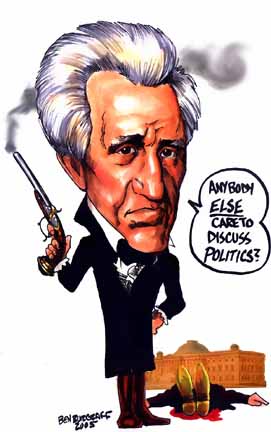
Andrew Jackson, as pictured during his service in the War of 1812.

They were wrong. The tariff wasn't repealed. Southern cotton went to Britain, which gave America lots of money. With all this new money, industrialization could just get stronger in the North since it could be widely financed. The South didn't industrialize, while the North did. As industry and the North grew, people tried to get more protective tariffs to make it grow even more. The whole thing was a bit self-perpetuating.

There was another tariff in 1824 which basically raised the 1816 tariff rates. This was the first time that many Southerners (who had supported the 1816 tariff) actually began to out right oppose raising the tariff rate. Many believed that this new tariff was not in national interest, but sectional interest, favoring the North and hurting the South. States that were part of the original Southern colonies were also going through some tougher times, so the tariff wasn't exactly appreciated. Among the opposition to the tariff was then Vice President John C. Calhoun from South Carolina, who had previously supported the 1816 tariff in order to raise revenue for the country. Like many other Southerners, he believed that this tariff was an unfair burden on the South and was purely for the North's benefit. There was also some opposition in New England against it among traders. (This tariff was pretty sectional, so you can't really blame the opposition for getting annoyed with it.)

 This picture of Errol Flynn is unrelated to anything I have to say in this post.

In 1828 the tariff was raised again, by the then President J. Q. Adams. Many were angry enough about it to give it the name "the Tariff of Abominations." In the election of that year, Andrew Jackson won the presidency, and Calhoun ran for Vice President under him and (again) won the office. He had been assured that Jackson would not support the tariff, but when he did (thanks on part to his Northern party members), Calhoun became displeased. Over the course of Jackson's presidency, conflicts over various policies and such only made relations between the two of them worse, and the Tariff of Abominations and what ensued because of it pretty much became the final straw.

Frustrated, Calhoun went back to his plantation in South Carolina and wrote a pamphlet entitled "Exposition and Protest." In it, he endorsed and argued for the idea of nullification, which says that a state may nullify (choose to ignore) any federal law that it finds to be unconstitutional. (He also said that if a state should decide to nullify, then a vote could be held among the states and if 3/4 ruled that the law was not unconstitutional, the nullifying state would have to follow suit with the law.) Accordingly, because the Tariff of Abominations was so one sided, South Carolina had every right to nullify the tariff should it choose to.Calhoun also went further to suggest that states could secede from the Union if the federal government proved not to be acting in its best interests and only harming it.


Here's an excerpt from the pamphlet. It sums up his thoughts on the 1828 tariff in brief:

"...the whole system of legislation imposing duties on imports, not for revenue, but the protection of one branch of industry at the expense of others, is unconstitutional, unequal, and oppressive, and calculated to corrupt the public virtue and destroy the liberty of the country...so partial are the effects of the system, that its burdens are exclusively on one side and its benefits on the other."

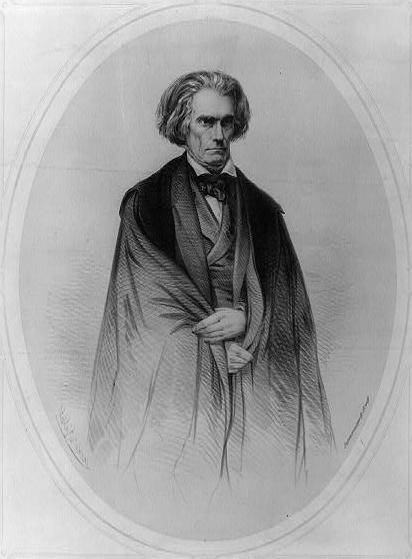
 John C. Calhoun; a cape-wearing 6'4'' Scots-Irish guy from the Antebellum South. More interesting than he looks and decidedly less creepy; I suggest you go check out a book on him from the library.

Calhoun wrote this anonymously so as not to get himself into too much trouble just yet, since he had his eye on succeeding Jackson as president or getting the office some time or other, (which never happened and was never going to happen anyways once 1828 came along) but many people suspected that he had written it anyway. In case you were wondering, Exposition and Protest did not have an effect on the proceedings regarding the tariff, but it did irk Jackson. Although he liked small government and state's rights, he believed in the Union, and thought nullification and secession were treasonous things to do to it.  

By 1832, nullification had become a topic of national debate. To calm the situation down, a revised tariff was created, but South Carolina was still not happy with the tariff rate it had set; it was still too high. Later in that same year, South Carolina (Calhoun's home state) decided that it'd had enough, and passed the Ordinance of Nullification to effectively nullify the 1828 and 1832 tariffs. The Nullification Crisis had officially begun! *drum roll*


Look what I found...

Jackson was highly displeased with S.C., and he was a guy that you probably didn't want to annoy. In 1833 he issued the Force Bill which would allow the tariff money to be collected from South Carolina by any means necessary. He also sent in the military and warships into Charleston harbor just in case the message wasn't clear enough. The little state smirked, and nullified that bill too.

Meanwhile, some South Carolinians (among others) began to make some extreme rallies and movements in support of nullification that were a little radical and could possibly create a volatile situation. Calhoun was a bit unnerved by this, and with his anger against Andrew Jackson contributing to the decision, decided to resign as Vice President and go spearhead the nullification movement. He joined the Senate (where he would remain 'til the end of his days, almost literally), and formed the short lived Nullifier Party. (It merged with the Democratic Party in 1839.) 

A little map of the state for you all...

On the same day that the Force Bill passed in 1833, Senator Henry Clay and Calhoun, now a senator himself, together authored the Compromise Tariff for a gradual reduction in tariff rates. South Carolina found this acceptable, and repealed the Ordinance of Nullification. Andrew Jackson also dropped the Force Bill, since South Carolina now intended to comply with federal law.

Amusingly, South Carolina kept the now-repealed Force Bill nullified, a fact which Jackson decided to ignore.


Stumble Upon Toolbar

Bacon's Rebellion

This is a re-post from my U.S. History blog.

Bacon's Rebellion took place in 1676 in Virginia Colony. The leader of the rebellion was Nathaniel Bacon, a wealthy tobacco planter. Why did he rebel? Was not the fact that his last name evokes the image of smoky crispy strips of goodness good enough for him?

I'm glad you asked. As a matter of fact, I'm here to help y'all find out.

Colonial times in all their fancy-coat-and-hat glory.

Virginia Colony was going through some tough times. Tobacco prices had sunk, and the colony faced competition from the Carolinas and Maryland. On top of that, England had barred trade with France for them, so they lost a whole market. Bad weather didn't help either.

When some Native Americans lead a mini-raid on someone's plantation, the Virginians decided to use them as a scapegoat for their troubles. A series of raids and violence went back and forth on either side, so Governor Berkley decided to pursue a policy of containment of the threat, and just build a bunch of forts. Settlers in the back-country questioned this plan's effectiveness, and many thought it was just an excuse to raise taxes. People didn't like Berkley much, and also accused him of appointing his friends to high government offices. Bacon lead some raids against the Native Americans, (even killing friendly groups), and was elected to the House of Burgesses for his efforts.

Nathaniel Bacon himself. 

Governor Berkley convened the HoB and when Bacon came, tried to have him arrested. This failed, and Bacon gathered his followers and coerced Berkley into allowing him continue his raids on Native Americans. Berkley agreed, and fled Jamestown to go raise a militia since Bacon had sort of taken over the Colony for a bit. Bacon died suddenly, and his rebellion collapsed without his leadership. Berkley came back to assume command, but was recalled to England (much to the delight of Virginia.)

Defending against Native Americans, although the colonists may have started this one...

Many joined Bacon's cause against Berkley and the Native Americans, including both black and white indentured servants. The economic situation hadn't been kind to them either, so they joined in the rebellion. For upper-class Virginians, seeing the indentured servants ban together and rebel was frightening, and what was especially frightening was the fact that they were black and white joined together.

This caused Virginia colony to start relying more on slave labor and being tougher on African-Americans, free or slave. Since indentured servants were unreliable in times like these (and because they were racist and didn't like blacks and whites joining together), Virginia decided it needed a safe, more permanent lower class of person. to work for them.

Stumble Upon Toolbar

Wednesday, April 21, 2010

The French and Indian War - Proclamation of 1763

This is a re-post from my US History blog. I will post content back and forth between the two.

The name "French and Indian War" (is the name for the part of the Seven Year's War that happened in North America. (The Seven Year's War was a European thing, although parts of it took place overseas, mostly in colonized areas.) Calling it the French and Indian War may be deceiving, since the French and (many of) the Native Americans actually fought on the same side against Great Britain, and not against each other as it may sound. On top of that, the Seven Year's War actually lasted for 9 years; 1754-1763. You love that, don't you?


In North America, the whole thing got started because Europe was still feverishly trying to colonize, or at least expand and maintain power. Now France had laid claim to the Mississippi watershed area as well as the Ohio Valley and the Great Lakes region, and had some forts and trading activity with the Native Americans going on. As time passed, the British colonies grew more prosperous, and people wanted to move out west over the Appalachian Mountains and set up shop in the rich Ohio Valley lands. The French weren't too happy with this British encroachments on "their" land, so they started building a string of forts to keep guard. Then, Britain built a couple of forts too; one in Oswego and the other in Halifax. (Oswego had started out a trading post below Lake Ontario, but was expanded to become a fort.)

British and French representatives met in Paris soon after, but no progress on the "who exactly has rights to the Ohio Valley, since the Native Americans obviously don't count" question was made. After that, France decided to just settle the situation by building even more forts even closer to British colonial soil, this time in Western Pennsylvania. At the same time, the governor of Virginia decided to start granting land in the Ohio Valley to Virginia citizens. To add to the trouble, a one George Washington decided to advise Britain to build a fort in a particularly nice location in the Ohio Valley, and so they did. Long story short, France captured it before it was finished, completed construction, and took it for their own. Washington then attacked the French, but he lost when re-enforcements came. Fort-wars then ensued for a while, until Britain finally decided it would be a good time to officially declare war in 1756.


The Native Americans (except the Iroquois Confederacy, who fought with Britain alongside some other tribes) sided with the French. France had a far more inclusive society in North America, and the Native Americans received less-meddling in their affairs on the part of France, and more friendliness and intermingling. The Native Americans would trade with the French, and fur trappers would actually bother to learn their languages, and sometimes even decided to marry the Native Americans too. In British society, things were decidedly less "chill;" they had an exclusive society. Things were more hostile, racist, and not as fair business wise with Native American-British relations, so understandably, most Native Americans decided to join France against Great Britain.

The war goes on, and Great Britain wins. The Native Americans aren't too happy, France gets kicked out of North America entirely, and ends up left with two small sugar islands. (Over Canada and the Ohio Valley, France decides to keep the sugar islands; this = importance of mercantilism!) Great Britain decides to raise the prices of goods sold to the Native Americans, and stops paying them for using forts on their land. They also stop giving exchanging gifts, which was an important and symbolic custom for the Native Americans, and they probably felt pretty offended that Britain just decided to stop it.


The Native Americans weren't feeling all that amiable towards the British, and when the prophet Neolin from a tribe in Delaware started preaching through ought the Great Lakes against materialism/alcohol/the English way of life, things didn't go well. On top of that, colonists had started to push further into Native American lands. The Ottawa war chief Pontiac, around the same time as Neolin was preaching, started a rebellion against the British and attacked colonists in the Ohio Valley; this was Pontiac's Rebellion (1763.) In response/anger, a group of colonists called the Paxton Boys in Western Pennsylvania attacked a peaceful group of Native Americans nearby and massacred them; partly out of racism and partly because they thought their government wasn't doing much to help them. Benjamin Franklin helped put an end to the killing by negotiating with the group, and was scathingly critical about their inhumane actions. Eventually, Great Britain decided to step in to end Pontiac's Rebellion, and did so, with the help of germ warfare in the form of smallpox infected blankets.

To ensure that something like that wouldn't happen again, the British government issued the Proclamation of 1763, which forbade settlement west of the Appalachian Mountains. This was an attempt to keep colonists out of the Ohio Valley, and out of trouble with the Native Americans. Colonists pretty much disregarded it, and moved westward anyways, angry at the British for placing this restriction on them. This was one of the first 'restrictive acts' that the British took against the colonists, and one that they became more resented for.


At the end of the French and Indian War, many British soldiers stayed in North America. Tensions increased between the colonists and the soldiers. Many colonists became disgusted/displeased with the behavior/attitudes/appearances of the soldiers, and felt that they had a more separate identity from them. The colonists also felt that Britain had under-appreciated the part that they had played in the fighting the war. During this time, a sense of common identity, separate from that of the British, became stronger, as well as resentment against Britain that would grow in the future.

Stumble Upon Toolbar

Friday, April 16, 2010

ISS Tour

This is a video that I found on YouTube; it's a tour of the International Space Station.


On-orbit construction began in 1988, and is set to finish late next year.

Stumble Upon Toolbar

Thursday, April 15, 2010

Tweet Database

The Library of Congress is archiving all tweets from Twitter made since the site's inception. This means the updates you posted on the Iranian election will be archived, as well as the tweets about how crunchy your toast was and that post you don't want your brother to know about.

Please click this link to know more:

http://blogs.loc.gov/loc/2010/04/how-tweet-it-is-library-acquires-entire-twitter-archive/

Hope this proves to be worth it!

Stumble Upon Toolbar

Photoshop CS5

One of the new features of Abode Photoshop CS5 is the content aware fill tool. It's like an automated version of the clone tool, and using it takes considerably less time for complex jobs than it would with the clone tool.


And here is a fun video based on the content aware fill tool. Enjoy.

Stumble Upon Toolbar